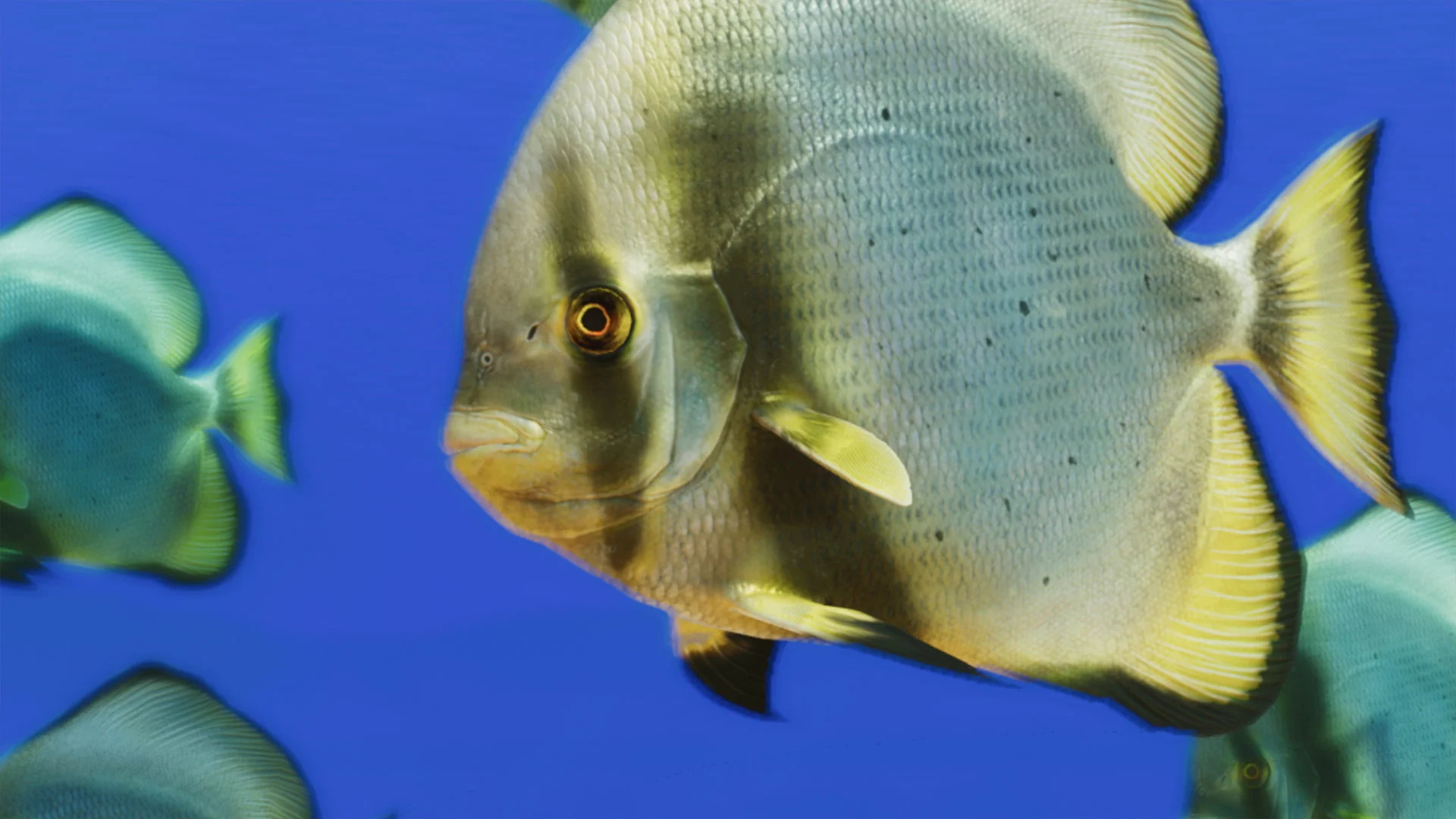
Platax pinnatus
About
General
The longfin batfish (or Platax pinnatus), also known as the pinnate spadefish; or pinnate, dusky, shaded or red-faced batfish, is a species of marine fish found in the tropical coastal regions of the West Pacific Ocean at depths between 3m and 25m.
They have a squat, round body with yellow pectoral fins and a yellow band at the base of their tail. The adults’ body is sliver to dark grey with black vertical bands along the side.
They measure 45cm to 60cm in length on average and weigh between 1.5kg and 3.5kg.
Conservation Status
The longfin batfish is of Least Concern due to its wide distribution but is nonetheless affected by conservation challenges across its range. In parts of its range, such as Southeast Asia and southern China, local populations have declined due to overfishing for food and the aquarium trade. Juveniles are especially valued by hobbyists for their unusual appearance. Habitat degradation through coastal development and mangrove loss is also a threat, reducing nursery habitats for juveniles. Coral bleaching caused by climate change further weakens reef ecosystems, which can affect longfin batfish survival and reproduction.
Several conservation strategies benefit the longfin batfish. Marine protected areas help preserve reef and mangrove habitats that are essential to the species’ life cycle and limit local overfishing. Captive breeding and large-scale aquaculture aim to reduce pressure on wild populations by supplying markets without further depletion of natural stocks.
Social & Reproduction
Longfin batfish are social and may be found alone, in pairs, small groups or large schools.
The longfin batfish reproduces year-round, but peaks occur in spring and summer. It has a reproductive cycle that is typical of many reef-associated marine fishes and is not marked by elaborate courtship displays. Adults usually form loose spawning aggregations, during which males and females release sperm and eggs into the open water for external fertilisation.
The fertilised eggs are pelagic, drifting with ocean currents until they hatch into tiny larvae. These larvae remain part of the plankton for a time before settling into shallow coastal habitats. Juvenile longfin batfish look vastly different to adults, with an orange-rimmed black body that resembles toxic flatworms, and as they grow, they gradually lose this camouflage.
They move into deeper reef or open-water environments and mature into their round, adult shape. Longfin batfishes are sexually mature between 2 to 4 years old.
Habitat
Social
Biology
 60 cm
60 cm 60 cm 3.5 kg 3.5 kg