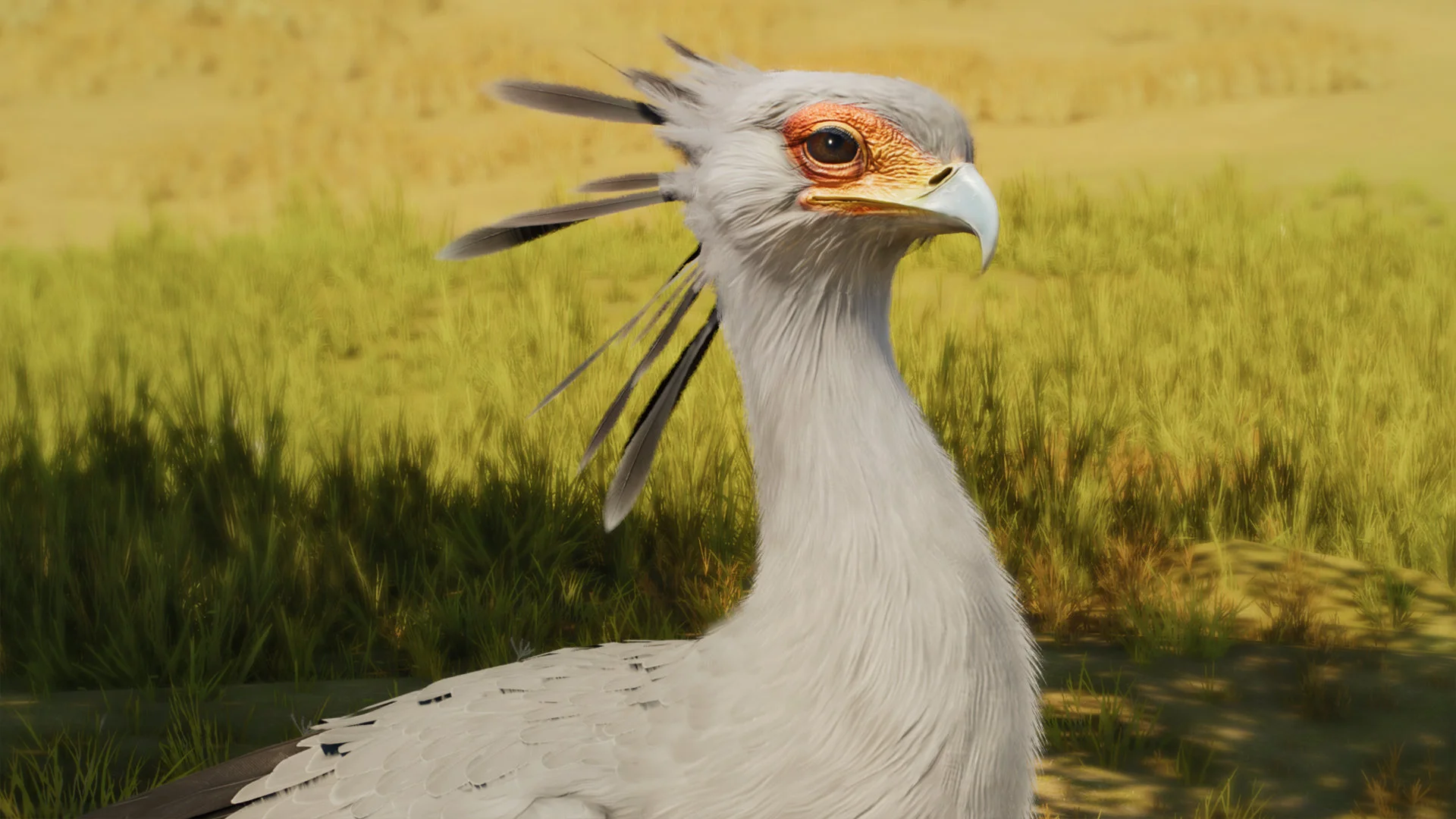
Sagittarius serpentarius
About
General
Wild Population: 6,700 - 67,000
The secretarybird (or Sagittarius serpentarius) is a large bird of prey that is found throughout the savannahs of Sub-Saharan Africa.
It has long legs, a white feathered body with black-tipped flight feathers on the wings, and black feathers on the thighs. The hooked beak is white, and there is orange-red colouration around the eyes. The secretarybird has a distinctive crest of black and white feathers that protrude around the face.
Both males and females measure between 1.2m and 1.5m tall, have a wingspan of 1.9m to 2.2m, and weigh between 3.7kg and 4.3kg. Some males may have slightly larger tail feathers or crests than females, but generally, both sexes look alike.
Conservation Status
Once listed as Vulnerable and now classified as Endangered, the secretarybird has declined strongly due to habitat loss and degradation. Much of the open grassland habitat they depend on has been converted for agricultural purposes, while changes in land use and management, such as excessive burning and intensive grazing, reduce prey availability and degrade hunting grounds. Furthermore, collisions with power lines, entanglement in fences, secondary poisoning from pesticides, and unpredictable climate extremes like increased heat and drought further compound these threats.
Long-term tracking, including citizen science reports, and ecological research on the secretarybird are means to understand and mitigate these issues. Collaboration with landowners seeks to promote wildlife-friendly farming practices. Modified fence design and marked powerlines can reduce infrastructure-related casualties. Captive breeding offers insight for potential releases into struggling wild populations. With these strategies, the hope is that existing populations can be protected and made more resilient in the face of climate change and expanding human pressures.
Social & Reproduction
Secretarybirds are monogamous and live in mated pairs.
While secretarybirds can mate year-round if prey is abundant, the peak is primarily in the rainy season. A male and female secretarybird find a thorny tree, usually acacia, where they build their nest as a large platform in the canopy. The pair will court by flying high and swooping low over each other and the nest, males often being more active. Mating usually takes place on the ground.
Soon after copulation, the female lays 1 to 3 eggs in the nest, usually laid 2 days apart. Both the male and female take it in turns to incubate the eggs for a total of 42 to 46 days until they hatch. After hatching, both parents hunt for food and visit the chicks to feed them 3 to 5 times a day. Between 63 and 106 days old, the chicks fledge, and parental care will stop.
Young fledglings leave their parents’ territory and attempt to find their own. Secretarybirds reach sexual maturity between 3 and 4 years old and begin searching for their own mate and nesting grounds at this point.
Habitat
Social
Biology
 1.5 m
1.5 m 1.5 m 4.3 kg 4.3 kg