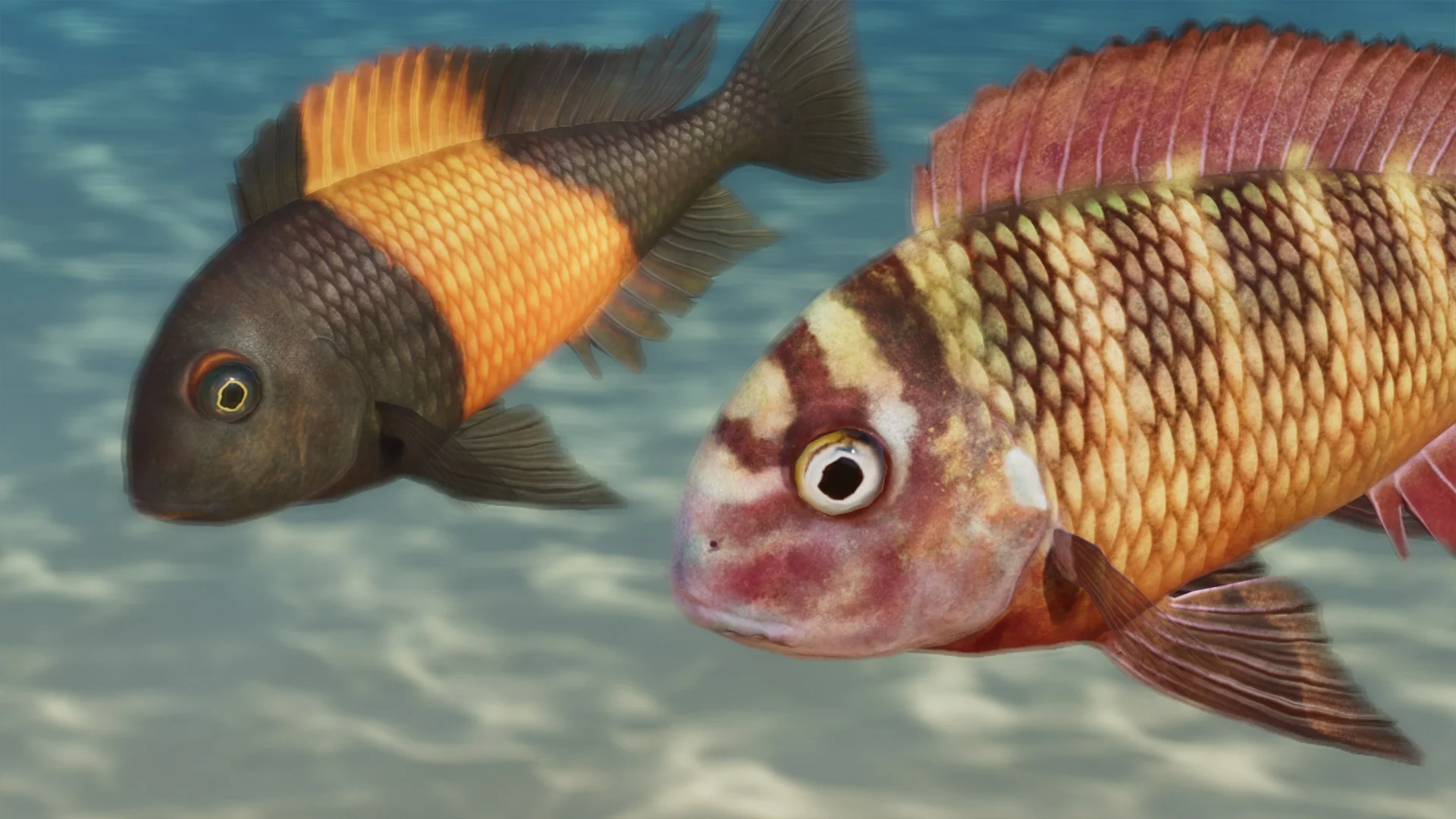
Tropheus moorii
About
General
The blunthead cichlid is a freshwater cichlid endemic to Lake Tanganyika in East Africa, where it inhabits shallow, rocky shorelines with strong water movement and abundant algae growth. Its range is highly localised, with many distinct colour forms restricted to specific stretches of rocky coastline within the lake. They are named for their characteristic rounded, blunt forehead, compact body, and small mouth adapted for grazing algae from rocks. They are best known for their striking colouration, which varies by population and may include deep blues, blacks, yellows, reds, or bold vertical bands, often with high contrast and intensity. Blunthead cichlids are relatively small but robust fish, typically reaching 10cm to 14cm long and weighing 40g to 80g as adults.
Conservation Status
The blunthead cichlid is a species with Near Threatened status. Lake Tanganyika is renowned for extraordinary diversity of cichlid fishes but is increasingly under pressure from human impacts. The broader ecosystem is threatened by overfishing, unsustainable fishing practices, habitat degradation from agricultural runoff and sedimentation, as well as the effects of climate change on water temperature and clarity. These pressures reduce algae growth on the rocky substrates, disrupt spawning territories, and cause population declines in colour morphs that occupy very restricted ranges. Lake Tanganyika is working at ecosystem-scale to establish fisheries best practices, patrol breeding habitats, and promote sustainable livelihoods that reduce pressure on wild fish stocks. Freshwater protected areas control or prohibit fishing, allowing endemic cichlids to breed and maintain genetic diversity. Community-based breeding facilities and trade initiatives aim to supply the aquarium market without depleting wild populations, while research programmes monitor the status of endemic species and inform sustainable extraction limits.
Social & Reproduction
Blunthead cichlids live in large social groups along rocky shorelines, where individuals maintain small feeding territories while remaining in close proximity to each other. Social interaction is constant and includes visual displays, chasing, and dominance posturing, which helps establish and maintain hierarchies. Breeding occurs year-round within its complex social and territorial system. Males establish and defend small feeding territories on algae-covered rocks, which they use as display sites to attract females with intense visual signalling, including body posturing, colour intensification, and circular swimming displays. When a receptive female enters a male's territory, spawning occurs on the rock surface: the female lays a small number of eggs, which she immediately collects into her mouth. Fertilisation then takes place using the 'egg-spot' mechanism, where the female attempts to pick up spots on the male's anal fin, allowing the male to release sperm into her mouth. Maternal mouthbrooding provides high protection but limits the number of offspring. Females typically brood 5 to 20 eggs in their mouth for about 4 to 5 weeks, during which time they do not feed and may retreat from social interactions. Once released, the fry are relatively large and well developed, allowing them to begin grazing on algae soon after independence. Juveniles grow slowly and gradually integrate into the social group, occupying lower-ranking positions until maturity. Sexual maturity is usually reached at around 1 year old.
Habitat
Social
Biology
 12 cm
12 cm 12 cm 60 g 60 g